Category Solutions

Outlook Reply Macro – VBA

This is in all honesty, is my most useful piece of automation, and it came in part because where I work we have an older version of Outlook, and I couldn’t use the Auto-Reply add-in “My Templates“. But I do have that same pain point that would warranty the need for that add in – really common questions via email, that I tire of retyping or searching for the last time I typed it to copy, paste then personalize.

Instead I added a little Macro (it’s actually a mid size one for me), that:

  • Gives me the options of custom replies
  • Asks me who I’m replying to
    • Adds a greeting based on the time of day
  • Injects the reply at the top of the email, and will even include up to one of each of the following
    • Embedded image
    • Attachment
      • You could always have sperate macros just to add attachments, or groups of

From there you might want to do some formatting – it is just injecting text (not formatting), so I go to any link and put a space right after it so it will automatically turn into a link, and other bits and bobs.

The Prequel

Before we jump to far in, this post is going to assume you know how to add a Macro and the shortcut to run it from Outlook. If not, then this post will help you through that:

The Code

There are some basic elements to this macro, and you can expand them to what ever scale you need. So lets look at the “components” one by one:

Collecting the Inputs

First we need to collect a few details, initially which email response you want and then a name for the reply greeting:

    '-----------------------------------------------------------------  +-+-+-+-+-+-+-+-+-+-+-+-+
    ' COLLECT REPOSPONSE CHOICE                                         +-+-+-+-+-+-+-+-+-+-+-+-+
    '-----------------------------------------------------------------  +-+-+-+-+-+-+-+-+-+-+-+-+

    responseChoice = InputBox("Choose response type:" & vbCrLf & vbCrLf & _
                             "[1] - Password Reset" & vbCrLf & _
                             "[2] - Project Access." & vbCrLf & _
                             "[3] - Software Installation" & vbCrLf & _
                             "[4] - Wrong Support" & vbCrLf & _
                             "Enter number (1-4):", "Email Response Template")                                                            
    ' Validate input                                                                                                                      
    If responseChoice = "" Or Not IsNumeric(responseChoice) Or Val(responseChoice) < 1 Or Val(responseChoice) > 4 Then 
        MsgBox "Invalid selection. Please run again and choose 1-4."  
        Exit Sub   
    End If   
    
    ' Get person's name  
    personName = InputBox("Enter the person's name (or leave blank for generic greeting):", "Recipient Name")  
    If personName = "" Then   
        personName = "there"  
    End If     

you’ll notice, that you can just press enter to speed through the second question, and the default “there” will be added for a “good morning there” or “good evening there“.

Generating that Greeting

This might not look like much (and it’s not), but this reusable beauty is what makes the that personalized response have a little polish. “Good Morning Dave” , is Personal, Polite, and Timely. A three factor illusion to makes it more than an automatic response.

    '-----------------------------------------------------------------  +-+-+-+-+-+-+-+-+-+-+-+-+
    ' GENERATE GREETING                                                 +-+-+-+-+-+-+-+-+-+-+-+-+
    '-----------------------------------------------------------------  +-+-+-+-+-+-+-+-+-+-+-+-+
    Dim timeGreeting As String 
    Select Case Hour(Now)   
        Case 5 To 11      
            timeGreeting = "Morning"   
        Case 12 To 17      
            timeGreeting = "Afternoon"  
        Case 18 To 21     
            timeGreeting = "Evening"  
        Case Else       
            timeGreeting = "Day" ' For very early morning/late night  
    End Select     

The Responses

Time to add the custom responses, you can build as many as you need – it injects itself at the top of the email

    '-----------------------------------------------------------------  +-+-+-+-+-+-+-+-+-+-+-+-+
    ' GENERATE RESPONSES                                                +-+-+-+-+-+-+-+-+-+-+-+-+
    '-----------------------------------------------------------------  +-+-+-+-+-+-+-+-+-+-+-+-+
    '
    '   attachmentPath="X:\Location\File.txt" will include a single attachment
    '   imagePath:="X:\Location\Picture.png" will include the picture in the [IMAGE] line 
    '                                        NOTE: you can only have one image
    '--------------------------------------------------------------------------------------------
    
    Select Case Val(responseChoice)
        Case 1 ' PASSWORD RESET
           responseText = "Good " & timeGreeting & " " & personName & "," & vbCrLf & vbCrLf & _
                          "We don't reset passwords manually for the Fantasy domain, and instead have a password portal that you can use to  reset your password from the the real world." & vbCrLf & vbCrLf & _
                          " Just follow this link, and enter you Fantasy username, and click submit: " & _
                          "https://FantasyCan.Works4Me.info" & vbCrLf & vbCrLf & _
                          " You will then recieve an email like below:" & vbCrLf & vbCrLf & _
                          "[IMAGE]" & vbCrLf & _
                          " Clicking the 'Yes please' button will take you to the password rest portal." 
            imagePath = "X:\location\Email_Example.png" 
        Case 2 ' PROJECT ACCESS                                                                                             
           responseText = "Good " & timeGreeting & " " & personName & "," & vbCrLf & vbCrLf & _
                           "Request to access the Fantasy project are done though a request portal, and not email." & vbCrLf & vbCrLf & _
                           " Simply go to " & _
                           "https://FantasyCan.Works4Me.info" & _
                           " and fill in the forms. I've also attached the Induction Guide so you know what to expect." & vbCrLf & vbCrLf & _
                           "Please read the guide before yo apply, as the Fantasy Domain may not be for you, and its resources are limited."
           attachmentPath = "X:\location\You and the Fantasy Guide.pdf"

        Case 3 ' SOFTWARE
           responseText = "Good " & timeGreeting & " " & personName & "," & vbCrLf & vbCrLf & _
                           "We utilise a self service portal that will display all the software available to you based on your departmental water cooler structure." & vbCrLf & _
                           "https://WillSoftware.Work4Me.info" & vbCrLf & vbCrLf & _
                           "If you can't find the software you want on the Self Service portal, then chances are you don't have the correct proximity to one or more water coolers." & vbCrLf & vbCrLf & _
                           "If in doubt, just check the Water Cooler map, and swap office with someone with better proximity " & vbCrLf & vbCrLf & _
                           "https://MoreWater.works4me.info"
        
        Case 4 ' OTHER GROUP
           responseText = "Good " & timeGreeting & " " & personName & "," & vbCrLf & vbCrLf & _
                          "I'm sorry to say that we don't operate the DarkFantasy domain. This is something you can discuss with ignoreme@will.com for such things, who I've CC'd into this response." & vbCrLf & vbCrLf & _
                          "I've attached the joys you could have with regular fantasy in our promotional pdf. If that doesn't move you, please consider this sad kitten meme below" & vbCrLf & vbCrLf & _
                          "[IMAGE]"
            ccEmail = "ignoreme@will.com"
            attachmentPath = "X:\location\The Fantasy for Everyone.pdf"
            imagePath = "X:\location\Sad Kitten.png"


    End Select

I do a basic trick here – where things are blank to begin with, and if a value is entered then the code will know to use the value in following sections.

You’ll notice the [IMAGE] bit can sit anywhere, and will be replaced by the value in imagePath.

Although I don’t do it above, you could use “imageScale” to scale the image as a percent if you require different sizing:

imagePath = "X:\location\Sad Kitten.png"
imageScale = 100

Add the Text and maybe an Image

This is the true guts of the code, to “do-section” – here we inject the message, but first if an image exists, it splits the text on that point and adds the image. This allows you to have the image first or last as well; but this code only allows for one image max as written.

    '-----------------------------------------------------------------  +-+-+-+-+-+-+-+-+-+-+-+-+
    ' INSERT IMAGE                                                      +-+-+-+-+-+-+-+-+-+-+-+-+
    '-----------------------------------------------------------------  +-+-+-+-+-+-+-+-+-+-+-+-+
    '
    ' This checks if the generated responseText include "[IMAGE]" then it will spit the 
    '  responseTest on that,and includes the image from the associated imagePath variable.
    '
    '--------------------------------------------------------------------------------------------
    If InStr(responseText, "[IMAGE]") > 0 Then
        ' Split text at image placeholder
        Dim beforeImage As String
        Dim afterImage As String
        Dim imagePos As Integer
        
        imagePos = InStr(responseText, "[IMAGE]")
        beforeImage = Left(responseText, imagePos - 1)
        afterImage = Mid(responseText, imagePos + 7) ' 7 = str length of "[IMAGE]"
        
        ' Insert text after image
        wdRange.InsertAfter afterImage & vbCrLf & vbCrLf
        
        If Dir(imagePath) <> "" Then
            wdRange.InsertAfter vbCrLf
            wdRange.Collapse Direction:=1
            
            ' Insert the image
            Dim inlineShape As Object
            Set inlineShape = wdRange.InlineShapes.AddPicture(imagePath, False, True)
            
            ' Optional: Resize image (adjust as needed)
            With inlineShape
                .ScaleHeight = imageScale ' % of original size    
                .ScaleWidth = imageScale  ' % of original size
            End With  
                                                                         
            wdRange.Collapse Direction:=1
            wdRange.InsertAfter vbCrLf
            wdRange.Collapse Direction:=1
        End If
        '----------------------------------------
        ' Insert text before image
        wdRange.InsertAfter beforeImage
        wdRange.Collapse Direction:=1 ' Move to end of inserted text
        '----------------------------------------
        
    Else
        ' No image, just insert text normally
        wdRange.InsertAfter responseText & vbCrLf & vbCrLf
    End If

Adding an Attachment

If you’ve opted for one, this bit of code adds an attachment. This is that bit I talked about having something empty by default, but if you do add something, then the code reacts.

    '-----------------------------------------------------------------  +-+-+-+-+-+-+-+-+-+-+-+-+
    ' ADD ATTACHMENT                                                    +-+-+-+-+-+-+-+-+-+-+-+-+
    '-----------------------------------------------------------------  +-+-+-+-+-+-+-+-+-+-+-+-+
    '
    ' This checks if you've included an attachment, and if so, adds it.
    '
    '--------------------------------------------------------------------------------------------
    If attachmentPath <> "" Then
        If Dir(attachmentPath) <> "" Then
            olItem.Attachments.Add attachmentPath
        End If
    End If

Finally adding to the CC

This is the latest addition, and was a request by a colleague. It effectively check if the email address is already in the TO or CC, then adds it to the CC if required

    '-----------------------------------------------------------------  +-+-+-+-+-+-+-+-+-+-+-+-+
    ' ADD Email to CC                                                   +-+-+-+-+-+-+-+-+-+-+-+-+
    '-----------------------------------------------------------------  +-+-+-+-+-+-+-+-+-+-+-+-+
    '
    ' This checks if you're ensuring an email address is included
    '
    '--------------------------------------------------------------------------------------------
     If ccEmail <> "" Then
        If InStr(LCase(olItem.To), LCase(ccEmail)) = 0 Then
            If InStr(LCase(olItem.CC), LCase(ccEmail)) = 0 Then
                ' Email not found in CC field
                If olItem.CC = "" Then
                    olItem.CC = ccEmail
                Else
                    olItem.CC = olItem.CC & "; " & ccEmail
                End If
            End If
        End if
    End if

Warning Note!

This macro runs only in a popped out email – you can’t run this from the viewing pane of Outlook. That’s why I’d recommend setting the shortcut to the macro as part of a popped out email, not Outlook it self – that being said, there is a check at the top to warn you:

    ' Check if we're in an active email
    Set currentInspector = Application.ActiveInspector
    If currentInspector Is Nothing Then
        MsgBox "Please open an email in its own window."
        Exit Sub
    End If

What it Doesn’t Do

Like all my solutions, these aren’t things I’ve written because I think you could use them, or because it might attract traffic to this site. These are the solutions I use to make my IT day smoother and easier. Which unfortunately means they can fall short of the perfect solution, for the functional one I needed. Here what you could add:

  • Handle Multiple Attachments
  • Additional word swaps to add customized responses
    • Another numbered set to add certain sub responses
    • Search for other bits to swap out like the department or other detail
  • Inject a specialized signature – or even options of signatures.

Download the Macro

Reply Options.vba https://github.com/Works4Me-Info/Outlook_Automatic_Replies
Event Log Properties – PowerShell

One of the best uses of PowerShell in my experience is auditing the Event Logs, and then emailing a HTML report highlighting issues. The issue I have had with that, is once I know what Event ID I want from what Event Log, is knowing what properties exactly to extract, so I can see the Person who did it, on what Machine it happened, what time the event happened. There are undoubtedly a bunch of things you might want, and the issue is many of the real gritty details are hidden in the Properties[x].Value component.

Trickier still the Account name might be Properties[6].Value in one Event Log, and then in Properties[4].Value in another.

Today we decided we wanted to add Password Changes for the Admin and Services accounts to our Audit script (Event ID 4723 and 4724 if done by the affected account, or my another account)

This script looks at roughly 20 AD Event IDs in the Security Log, so I needed to look inside or trawl the internet (once again) for what was stored where, so I could do a foreach ($event in $global:EventLogs), that would extract the accounts involved and some other details.

The Script

I’ve used my Base Menu Script (read about it here), so there is a bunch of structure in there to make it dynamic, smooth and easy to read and edit, but in the guts there are two key components:

Reading an Event Log

#------------------------------------------------------------------------------------------------
#  Do the Scan of the Targeted Event Log
#------------------------------------------------------------------------------------------------
Function Do-Scan{

    cls
    #Converts the Hours back in to Milliseconds back
    $GoTime  = $global:HoursBack*3600000
    #Create XML Filter
    $FilterSEC = '<QueryList>
                    <Query Id="0" Path="'
    $FilterSEC += $global:Events
    $FilterSEC += '">
                        <Select Path="'
    $FilterSEC += $global:Events
    $FilterSEC += '">*[System[(EventID='
    $FilterSEC += $global:EventID
    $FilterSEC += ') and TimeCreated[timediff(@SystemTime) <= ' 
    $FilterSEC += $GoTime         
    $FilterSEC += ']]]</Select>
                    </Query>
                    </QueryList>'
	
    $global:eventslog = Get-WinEvent -ComputerName $global:LogServer -FilterXml $FilterSEC	

   $ErrorActionPreference= 'continue' 
   Show-Results
    
        
}

I always do my Event queries as Get-WinEvent and -FilterXML; I find them to be the quickest to run, and you really want to lock down that filter, as you may want to target all the DCs, and when doing that you really want that filter to be targeting only the Events you actually want.

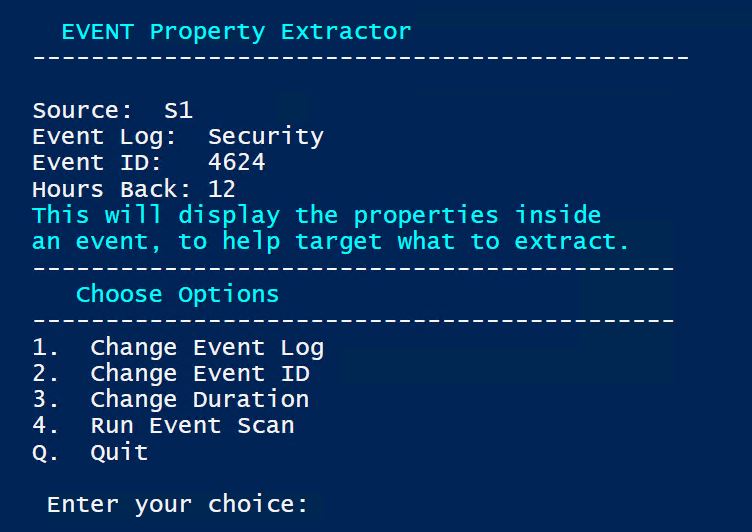
You’ll notice the $FilterSec is made up of other components that you can change from the menu as shown below:

Menu – Showing what can be changed.

Outputting all the Events Properties

#------------------------------------------------------------------------------------------------
#  Show Results in two Formats
#------------------------------------------------------------------------------------------------
Function Show-Results{

    Write-Host "     EVENT Property Extractor"  -ForegroundColor Cyan
    Write-Host "   ---------------------------------------------"
    Write-Host "  "
    Write-Host "   Source: " $global:LogServer
    Write-Host "   Event Log: " $global:Events
    Write-Host "   Event ID:  " $global:EventID
    Write-Host "   Hours Back:" $global:HoursBack

    $global:eventslog | select-object -First 1 | fl -Property * | Out-host

    $once=$true
    foreach ($e in $global:eventslog) {
        if ($once -eq $true){
            write-host "Properties[0].Value   :"$e.Properties[0].Value
            write-host "Properties[1].Value   :"$e.Properties[1].Value
            write-host "Properties[2].Value   :"$e.Properties[2].Value
            write-host "Properties[3].Value   :"$e.Properties[3].Value
            write-host "Properties[4].Value   :"$e.Properties[4].Value
            write-host "Properties[5].Value   :"$e.Properties[5].Value
            write-host "Properties[6].Value   :"$e.Properties[6].Value
            write-host "Properties[7].Value   :"$e.Properties[7].Value
            write-host "Properties[8].Value   :"$e.Properties[8].Value
            write-host "Properties[9].Value   :"$e.Properties[9].Value

            write-host "Properties[10].Value   :"$e.Properties[10].Value
            write-host "Properties[11].Value   :"$e.Properties[11].Value
            write-host "Properties[12].Value   :"$e.Properties[12].Value
            write-host "Properties[13].Value   :"$e.Properties[13].Value
            write-host "Properties[14].Value   :"$e.Properties[14].Value
            write-host "Properties[15].Value   :"$e.Properties[15].Value
            write-host "Properties[16].Value   :"$e.Properties[16].Value
            write-host "Properties[17].Value   :"$e.Properties[17].Value
            write-host "Properties[18].Value   :"$e.Properties[18].Value
            write-host "Properties[19].Value   :"$e.Properties[19].Value

            write-host "Properties[20].Value   :"$e.Properties[20].Value
            write-host "Properties[21].Value   :"$e.Properties[21].Value
            write-host "Properties[22].Value   :"$e.Properties[22].Value
            write-host "Properties[23].Value   :"$e.Properties[23].Value
            write-host "Properties[24].Value   :"$e.Properties[24].Value
            write-host "Properties[25].Value   :"$e.Properties[25].Value
            write-host "Properties[26].Value   :"$e.Properties[26].Value
            write-host "Properties[27].Value   :"$e.Properties[27].Value
            write-host "Properties[28].Value   :"$e.Properties[28].Value
            write-host "Properties[29].Value   :"$e.Properties[29].Value
        }
        $once=$false
    }
     Make-Menu -MenuTitle "Do Another?" `
    -Option1 "Yes" -Function1 "Do-Welcome" `
    -Option2 "No" -Function2 "Get-Quiting" 
}

Finally the results, which we dump the default view, and then go through 30 other possible values that could be buried in the Message part of the Event, and are often the key information you are looking for.

What it Doesn’t Do

Because this is just a tool that you will use to help you write actual functional scripts, I didn’t make it perfectly polished, or with error handling. Here’s what is doesn’t do:

  • Check if a Event ID of that type exists.
  • Restrict the Event Log selection to only valid sources.
  • Allow you to enter a Log Server source.
  • Allow you to move through a series of the Events with the full display.

Remember its a quick tool just for helping me find the properties of (in my specific case today), who’s password was changed, and who did the changing.

Download the Script

EventLog_Props.ps1 https://github.com/Works4Me-Info/PS_EventLog-Properties

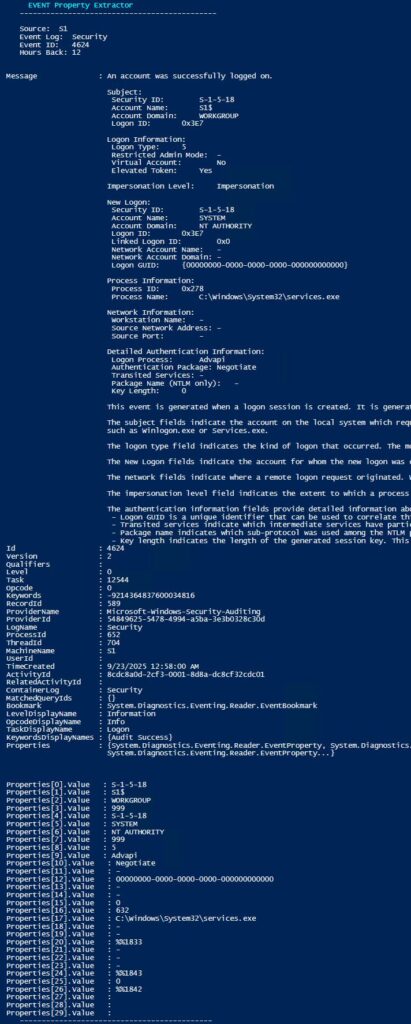
Below is an example of the kind of output you would expect to see. I’ve put it at the bottom here, so it doesn’t hide the Download option.

Example Output

Personalised Email Templates – VBA

Are you sending the same email over and over again, with just a few alterations? I know I do, and one of the easiest ways is to open an oft template and then change some words.

Adding a Macro

You can use this post to see how to add macros, and how to enable a button for it:

The Solution

This is a simple two part solution:

1. The Email Template

Which has [TARGET] words that will be replaced from questions that are asked by input boxes.

2. The VBA Macro

This will open the Macro, ask you some Inputs, and then replace the [TARGET] words with what you entered in the inputs.

The Template

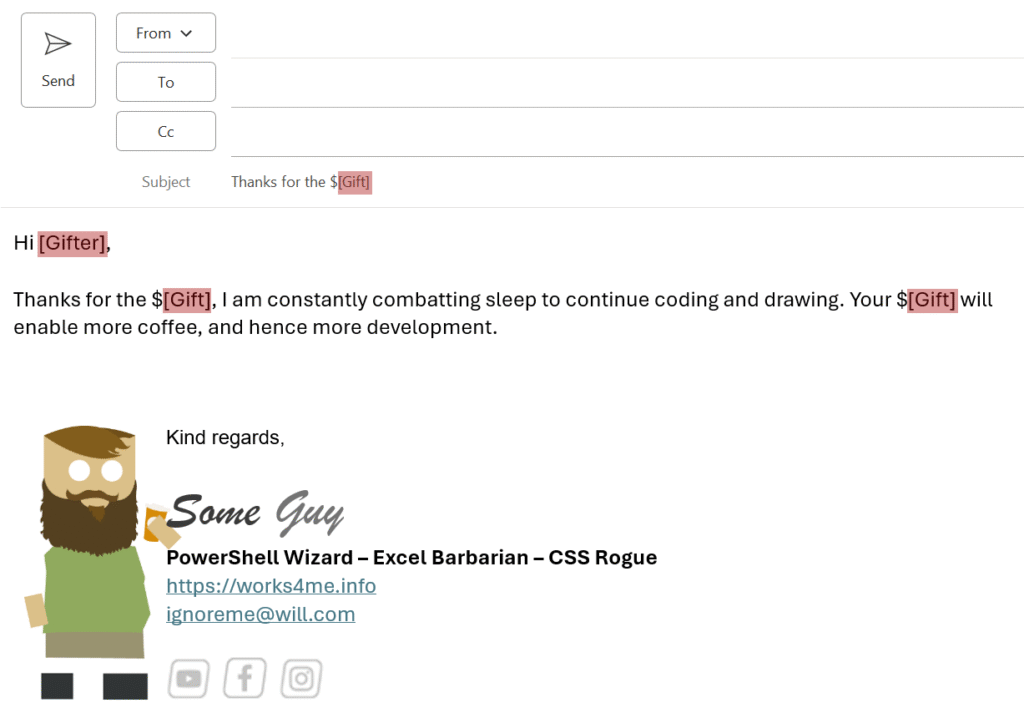
This is the easy part, just build an email then opt to Save As the message, as a template (*.oft). This is the example of the one used by the code. You’ll see three uses of [Gift] and one of the [Gifter] target words.

I’ve used a word inside the square brackers [TARGET]

The Code

Theres a lot you can do here, but I’ve opted for the basics – targeting words in the subject line and the body of the message.

You run the Coffee_Thanks() as a Quick Access button, which for each replacement the script calls the replaceText() sub.

Sub Coffee_Thanks()
    
    '+-+-+-+-+-+-+-+-+-+-+-+-+-+-+-+-+-+-+-+-+-+-+-+-+-+-+-+-+-+-+-+-+-+-+-+-+-+-+-+-+-+-+-+-+-+-'
    '  VARIABLES  -------------------------------------------------------------------------------'
    '+-+-+-+-+-+-+-+-+-+-+-+-+-+-+-+-+-+-+-+-+-+-+-+-+-+-+-+-+-+-+-+-+-+-+-+-+-+-+-+-+-+-+-+-+-+-'
        'DATA----------------------------------------  
        Dim CoffeeAmount As String 
        Dim personName As String 
        'TEMPLATE------------------------------------ 
        Dim newItem As Outlook.MailItem  
        'REPLACEMENTS-------------------------------- 
        Dim wdDoc As Object 
        Dim olItem As Object 
        Dim olInsp As Outlook.inspector 
    '+-+-+-+-+-+-+-+-+-+-+-+-+-+-+-+-+-+-+-+-+-+-+-+-+-+-+-+-+-+-+-+-+-+-+-+-+-+-+-+-+-+-+-+-+-+-'


    '+-+-+-+-+-+-+-+-+-+-+-+-+-+-+-+-+-+-+-+-+-+-+-+-+-+-+-+-+-+-+-+-+-+-+-+-+-+-+-+-+-+-+-+-+-+-'
    '  GATHER INFO ------------------------------------------------------------------------------'
    '+-+-+-+-+-+-+-+-+-+-+-+-+-+-+-+-+-+-+-+-+-+-+-+-+-+-+-+-+-+-+-+-+-+-+-+-+-+-+-+-+-+-+-+-+-+-'
       ' Gather additional information-------------- 
        CoffeeAmount = InputBox("Coffee Gift in $:")    
        personName = InputBox("Recipients name:")
    '+-+-+-+-+-+-+-+-+-+-+-+-+-+-+-+-+-+-+-+-+-+-+-+-+-+-+-+-+-+-+-+-+-+-+-+-+-+-+-+-+-+-+-+-+-+-'


    '+-+-+-+-+-+-+-+-+-+-+-+-+-+-+-+-+-+-+-+-+-+-+-+-+-+-+-+-+-+-+-+-+-+-+-+-+-+-+-+-+-+-+-+-+-+-'
    '  OPEN TEMPLATE ----------------------------------------------------------------------------'
    '+-+-+-+-+-+-+-+-+-+-+-+-+-+-+-+-+-+-+-+-+-+-+-+-+-+-+-+-+-+-+-+-+-+-+-+-+-+-+-+-+-+-+-+-+-+-'
        ' open Template------------------------------  
        Set newItem = Application.CreateItemFromTemplate("D:\Templates\Outlook\Coffee_Thanks.oft")
        newItem.Display
    '+-+-+-+-+-+-+-+-+-+-+-+-+-+-+-+-+-+-+-+-+-+-+-+-+-+-+-+-+-+-+-+-+-+-+-+-+-+-+-+-+-+-+-+-+-+-'


    '+-+-+-+-+-+-+-+-+-+-+-+-+-+-+-+-+-+-+-+-+-+-+-+-+-+-+-+-+-+-+-+-+-+-+-+-+-+-+-+-+-+-+-+-+-+-'
    '  TEXT REPLACEMENTS ------------------------------------------------------------------------'
    '+-+-+-+-+-+-+-+-+-+-+-+-+-+-+-+-+-+-+-+-+-+-+-+-+-+-+-+-+-+-+-+-+-+-+-+-+-+-+-+-+-+-+-+-+-+-'
       ' Set up for changes-------------------------  
		   ' Word Swaps in Subject line-----------------  
				Set olInsp = Application.ActiveInspector  
				Set olItem = olInsp.currentItem  
			 ' Word swaps in Body--------------------------
				Set wdDoc = newItem.GetInspector.WordEditor 

		   ' Replace all placeholders-------------------   
        olItem.Subject = Replace(olItem.Subject, "[Gift]", CoffeeAmount) 
        Call replaceText(wdDoc, "[Gifter]", personName)
        Call replaceText(wdDoc, "[Gift]", CoffeeAmount)
    '+-+-+-+-+-+-+-+-+-+-+-+-+-+-+-+-+-+-+-+-+-+-+-+-+-+-+-+-+-+-+-+-+-+-+-+-+-+-+-+-+-+-+-+-+-+-'
    
End Sub

Sub replaceText(wdDoc As Object, findText As String, replaceText As String)
	'+-+-+-+-+-+-+-+-+-+-+-+-+-+-+-+-+-+-+-+-+-+-+-+-+-+-+-+-+-+-+-+-+-+-+-+-+-+-+-+-+-+-+-+-+-+-'
    '+-+-+-+-+-+-+-+-+-+-+-+-+-+-+-+-+-+-+-+-+-+-+-+-+-+-+-+-+-+-+-+-+-+-+-+-+-+-+-+-+-+-+-+-+-+-'
    ' Repeatable loop to replace words in the body, without altering
    ' the HTML formatting.
	'+-+-+-+-+-+-+-+-+-+-+-+-+-+-+-+-+-+-+-+-+-+-+-+-+-+-+-+-+-+-+-+-+-+-+-+-+-+-+-+-+-+-+-+-+-+-'
    With wdDoc.Content.Find
        .Text = findText
        .Replacement.Text = replaceText
        .Execute Replace:=2 ' 2 = Replace all
    End With
End Sub

NOTE: I’ve saved my oft template to “D:\Templates\Outlook\Coffee_Thanks.oft”, you will need to change the code to point to where ever you have saved the template.

There’s a mountain different ways to use this, and you can do various other things like:

  • Calculate the time of day to tweak the greating to a good morning, or afternoon.
  • Find out when the next weekend is, because you’re using this to warn about patching.
  • Add people to the CC or BC fields.
  • Use input choices to add different content.

Download the Code

WordReplacement.vb https://github.com/Works4Me-Info/Outlook-Macros

Dynamic Menus – PowerShell

When you’re writing a PowerShell script as a tool, you’ll probably want to put in a Menu at some point, allowing for options and user input.

This works well at first, and you’ll use this little While / Switch version (a select statement in the old VBS days) over an over again in lots of different places of your script, and lot of different scripts.

Basic Menu

Function Do-Menu_01 {
    cls
    $x=1

    Write-Host "   ----------------------"
    Write-Host "     Basic Menu"
    Write-Host "   ----------------------"
    Write-Host "   1. Load File"
    Write-Host "   2. Do Process"
    Write-Host "   3. Open New Menu"
    Write-Host "   Q. Exit"
    
    $choice = 0
    
    while ($choice -ne "Q") {
        $choice = Read-Host "    Enter your Location choice (1-3)"

        # Take action based on user input
        switch ($choice) {
            1 { 
                Write-Host "   1. You load the file"
              }
            2 { 
                Write-Host "   2. You do the Computer Math"
                $x=$x+2
                $y=$x*2
              }
            3 { 
                Write-Host "   3. We open another Menu"
                $choice = "Q"
                Do-Menu_02
              }
            "q"{
                $choice = "Q"
               }
            "Q" { Exit }
            default { Write-Host "Invalid option. Please try again."; continue }
        }
    }
}

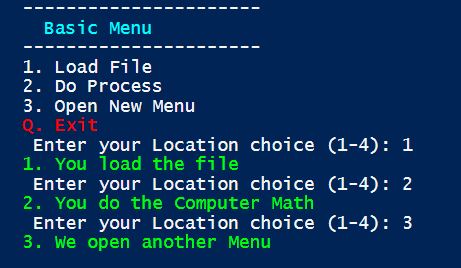
Building something like this:

Basic Menu in action (with added foreground color not in the code)

This works great on a small scale, and you could use the same menu code several times, and even have some code buried in that Switch section, or call functions that then do bits and pieces. As this script grows, going in and tweaking it, adding to it, and troubleshooting it will eventually become a nightmare.

Worse yet, you might even try to bury one Menu inside another as a sub menu, so you can exit one and come back into the first. Trust me, this is a disaster waiting to happen.

My scripts were getting so big, I needed to build a more dynamic and stable way of doing things. So the Make-Menu Function was born, and it changed my scripts forever. You can just tell it what you want the menu to have, and what separate function it should run for each option.

This means every function that has a menu, just has this simple bit of code to build the menu at the bottom.

The Dynamic Menu Function

function Make-Menu {
    
    # You can add more, but this allow an initial
    # 6 options, a quit menu, and the option to 

    param (
        [string]$MenuTitle = $null,
        [string]$Option1 = $null,
        [string]$Function1 = $null,
        [string]$Option2 = $null,
        [string]$Function2 = $null,
        [string]$Option3 = $null,
        [string]$Function3 = $null,
        [string]$Option4 = $null,
        [string]$Function4 = $null,
        [string]$Option5 = $null,
        [string]$Function5 = $null,
        [string]$Option6 = $null,
        [string]$Function6 = $null,
        [Switch]$OptionQuit
    )


    # This prevents the Colour bleeds while in Powershell ISE.
    # You won't need this in a normal Powershell Console.
    #---------------------------------------------------------
    # Start-Sleep -Seconds 1

    Write-Host "   --------------------------------------------"
    Write-Host "     " $MenuTitle -ForegroundColor Cyan
    Write-Host "   --------------------------------------------"
    if($Option1 -ne ""){
        Write-Host "   1. " $Option1
    }
    if($Option2 -ne ""){
        Write-Host "   2. " $Option2
    }
    if($Option3 -ne ""){
        Write-Host "   3. " $Option3
    }
    if($Option4 -ne ""){
        Write-Host "   4. " $Option4
    }
    if($Option5 -ne ""){
        Write-Host "   5. " $Option5
    }
    if($Option6 -ne ""){
        Write-Host "   6. " $Option6
    }
    if($OptionQuit -eq $true){
        Write-Host "   Q.  Quit" -ForegroundColor Red
    }
    Write-Host " " 

    $choice01 = 0
    while ($choice01 -ne "Q") {
        $choice01 = Read-Host "    Enter your choice"

        # Take action based on user input
        switch ($choice01) {
            1 { 
                if($Option1 -ne ""){                       #--------------------------------------
                    cls                                    #  Note: Every choice will end the Menu
                    $test = & $Function1.ToString()        #  by setting $Choice01 to "Q".
                    $choice01="Q"                          #  This means wherever you go, you 
                }                                          #  need to Call this Function again.
              }                                            #--------------------------------------
            2 { 
                if($Option2 -ne ""){
                    cls                    
                    $test = & $Function2.ToString()
                    $choice01="Q"
                } 
              }
            3 { 
                if($Option3 -ne ""){
                    cls                    
                    $test = & $Function3.ToString()
                    $choice01="Q"
                } 
              }
            4 { 
                if($Option4 -ne ""){
                    cls                    
                    $test = & $Function4.ToString()
                    $choice01="Q"
                } 
              }
            5 { 
                if($Option5 -ne ""){
                    cls                    
                    $test = & $Function5.ToString()
                    $choice01="Q"
                } 
              }

            6 { 
                if($Option6 -ne ""){
                    cls                    
                    $test = & $Function6.ToString()
                    $choice01="Q"
                }
              }
            # The final conditions are for Quitting, and it changes a 
            # lower case "q" into a "Q", so that you use the default quit
            "q" { 
                $choice01="Q"
              }
            "Q" { Get-Quiting }
            default { Write-Host "Invalid option. Please try again." -foregroundcolor red; continue }
        }
    }
}

Lets look at how this works, with an example function ‘Do-Welcome””

function Do-Welcome {
     
    cls
    Make-Menu -OptionQuit -MenuTitle "WELCOME Menu" `
    -Option1 "Display User" -Function1 "Do-Main01" `
    -Option2 "Display Day" -Function2 "Do-Main02" `
    -Option3 "Other Options" -Function3 "Do-SubMenu"
}

As you can see you can just include a quit option, a menu title and then the Options you want along with the an associated Function.

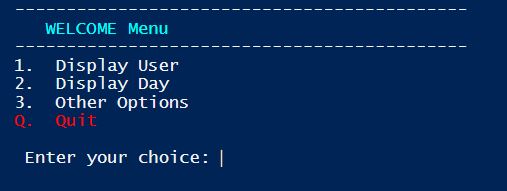
The above Do-Welcome function would look like this (you can see the title function was included when I ran this)

So then lets look at three functions it will call:

#-------------------------------------------------------------------------------------------------
####    Main Option 1 
#-------------------------------------------------------------------------------------------------
Function Do-Main01{
     
    Do-Option01
    Write-Host "  This will reuse the Do-Welcome function"
    Pause
    Do-Welcome
}
 
#-------------------------------------------------------------------------------------------------
####    Main Option 2 
#-------------------------------------------------------------------------------------------------
Function Do-Main02{
     
    Write-Host " "
    Write-Host "  Today is" $global:Today -ForegroundColor Green
    Write-Host "  This will REBUILD the Do-Welcome Menu"
    Pause
    cls
    Make-Menu -OptionQuit -MenuTitle "WELCOME Menu" `
        -Option1 "Display User" -Function1 "Do-Main01" `
        -Option2 "Display Day" -Function2 "Do-Main02" `
        -Option3 "Other Options" -Function3 "Do-SubMenu"
}
 
#-------------------------------------------------------------------------------------------------
####    Sub Menu Option 3 
#-------------------------------------------------------------------------------------------------
Function Do-SubMenu{

    # This checks if you should add the Description or not
    # which isn't important to the script, but just demonstrates 
    # what you can do, to control the GUI
    if ($global:AddDescription -eq $False){
            # It will reset it to always show,
            # so you need to decide to hide it
            $global:AddDescription = $True
    }Else{
        Write-Host "  "
        Write-Host "     Some additional Section or Function"  -ForegroundColor Cyan
        Write-Host "   -------------------------------------------------"
        Write-Host "  "
        Write-Host "   This would be where you add something special or"
        Write-Host "   maybe you run / call a bunch of other functions,"
        Write-Host "   but thats really up to you."
        Write-Host "  "
        Write-Host "  "
        Write-Host "   The real key is to watch where you use the " -NoNewline
        Write-Host "cls" -ForegroundColor Green
        Write-Host "   code, so that the Menu sits under the data you "
        Write-Host "   have displayed, like so:"
    }
    Write-Host "  "
    Make-Menu -MenuTitle "Sub Structure" `
        -Option1 "Display User" -Function1 "Do-Sub01" `
        -Option2 "Display Day" -Function2 "Do-Sub02" `
        -Option3 "Reload the Description" -Function3 "Do-Sub03" `
        -Option4 "Main Menu " -Function4 "Do-Welcome"
}

As you can see you just call Functions as the Menu choices, and you can use reuse Functions to build repeated menus or build the Menus on the fly.

The point is, the menu aspect becomes very simple and easy to update and change.

I personally like having functions for the repeated Menus. Like we see in Do-Main01, it just calls the Do-Welcome Menu.

Traps to Lookout for

  • When you call the menu function, if you are doing it like I do on multiple lines (so it’s easier to read), remember to put the ” ` ” character at the end of the line in which another line follows.
  • Make sure your Options and Functions line up number wise and make sense. Don’t use Option 1,2,4 & 6.

Download the Script

Base_Menu_2.0.ps1 https://github.com/Works4Me-Info/PS_Menu